



Hello stars,
It should come as no surprise that I talk a lot of sh*t.
“Strong opinions, loosely held,” I like to say. As a triple fire sign, I love to complain, judge, pile on, make conversation, etc. Gossip is an art, okay? It’s FUN, not usually serious!! But while I’m generally hard to impress, I am always open to changing my mind.
I’ve talked a LOT of sh*t about the Hamptons (expensive, lack of diversity, played out). I’ve talked even more sh*t about creator economy tools (unsophisticated, cash grabs, irrelevant). And yet, at 9 a.m. on a random Tuesday in August, I found myself on the Long Island Rail Road heading out east for lunch with a creator economy startup.
There were a myriad of brand events taking place in the Hamptons, and I thought maybe, if just I dressed the trip up with a color-coded calendar, I could call it an intentional business excursion!
But truthfully, I still had low expectations for the ROI. I had deadlines, admin, writing to finish and absolutely no guarantee that this lunch would be worth the money or the hours spent commuting, but stepping off the train to fresh air and actual silence had me in the mood to make the most of it.
I had no idea that YouPop’s lead investor, Kate McAndrew, was hosting a dinner the next night. I had no idea I would end up at that dinner seated next to the founder. I definitely did not know that less than three weeks later I would be back in a tech office with a new role and a new team, but here we are.
I don’t believe in most creator tools
The creator economy is growing quickly, which means it attracts the exact type of person who’s ready to exploit a promising CAGR and raise a million dollars for a “brand-creator connector tool,” or “better affiliate linking!” and starts building before ever speaking to a real influencer or bothering to download CapCut.
Meanwhile, actual creator businesses are held together with 17 spreadsheets, disappearing email threads, scattered contracts, six revenue streams on 10 platforms and the increasingly questionable memory of the creator who is also the talent, strategist, salesperson, finance department and creative director.
I KNOW this because I have been DOING IT for six years. I have missed revenue because something was disorganized. I have lost hours re-editing because I filmed the wrong concept. I have watched these flashy creator “tools” solve one tiny part of a marketer’s job while creating three more tabs I have to keep open.
So when I arrived at the YouPop lunch, I was prepared to be skeptical. Soon, I became irritated.
YouPop’s founder, Sarina Virk Torrendell, was employee number 12 at Postmates and went on to work across verticals at Apple Pay, Meta and Amazon. She understood both how hard it is to build consumer technology and the exact problem creators were living with.
Then Kate McAndrew, YouPop’s lead investor (who you’ve probably seen on your TikTok feed), explained the diligence behind her conviction in Sarina—not only as someone with the idea, but as an operator who could actually ship it.
That mattered because the concept itself made total sense. I had thought endlessly about the problem too: creators need one place to run businesses that have outgrown the systems we stitched together ourselves. But I didn’t trust many people to build that until I heard Kate’s conviction.
A good founder is one thing, but the engineering power is what really sold me. From working on YouTube Shorts, I know how difficult it is to build something that looks simple to the person using it. The more I understood what they had already built—and how much real creator context was imperative to make it better—the more irritated I became.
Following Your Frustration
One thing I have learned about myself in the last year is that my frustration is exceptionally useful information.
I used to suppress it—being called an angry Black girl one too many times growing up will do that to you—but now I realize that frustration is typically the first evidence that something matters to me.
Like, when I get upset that someone does not understand something, it often means two things: I have the capacity to explain it, and I care enough to want them to understand.
I could immediately see how necessary this product was. I could also see how much context from a real creator business it would need in order to become truly indispensable.
I sat on the couch quietly bubbling. My mind was flooded with opinions, ideas, and extremely specific thoughts about how creators actually operate once our businesses become bigger than a Notes app, a prayer and one very stressed assistant (sorry Martina!)
Something switched on.

I was irritated because I knew this needed to be built, and I knew that if it was built wrong, that was going to piss me off.
While lunch was a gathering of creators who were also angel investors, and YouPop was primarily looking for creator advisors, I knew I wanted to contribute more deeply, so I quickly made a beeline for the team to tell them I wanted to be more involved.
It reminded me of how I felt when I moved into YouTube Shorts. I had spent years developing instincts about content, creators and audiences, and suddenly there was somewhere useful for all of that knowledge to go. (And yes, my manager did say he hired me because I talked sh*t about YouTube in the interview.)
That feeling does not mean every annoying situation is your calling: maybe you don’t need to become the Chief Operating Officer of your workout studio because the booking system isn’t advanced enough!!!
But when frustration comes with clarity—when you can see the missing piece and know exactly what you could contribute—it is worth paying attention.
The details of what happened next do not really matter to you, but what does matter is that I found myself at dinner with Sarina the next night, and less than three weeks later I arrived at the office for my first day as Head of Creator Growth and Product at a pre-seed startup. LOL.
Chaos begets connection
My creator business has made more money this year than ever before. I just hit 50,000 followers on Instagram. The brand deals are getting bigger, better and more aligned. This summer alone, I was featured in People, Vogue Business, and Byrdie. I have a newsletter, a podcast, speaking, education products, advisory work and a book that I am actively working to bring into the world.
So why would I add this role to something that’s already working?
I talk constantly about going from chaotic to intentional, but I do not think becoming intentional means eliminating every impulsive decision from your life. Sometimes stepping outside your perfectly rational plan is how you expand the opportunities available to you. The intentional work begins when you decide what to do with what you found there.

Lord knows I didn’t need another job, but I have been craving a challenge and some structure for a LONG time now. I was getting that with book writing and courses, but it is still pretty lonely, and I feel my best when I’m in community.
I’ve been teaching, but I’ve been desperate to learn. At 27, I know I don’t know everything, and I know that I want to have so much potential that I wanted to get closer to.
I knew my strongest skills. I knew which problems I wanted to solve. I knew what I wanted to learn, where I could make a distinctive contribution and what I was unwilling to give up.
I had also spent the last year building more structure and team support across my business, meaning I had the space to meet my current obligations while also taking on a new role.
The opportunity had to make the entire system stronger. Because I had spent years reflecting on what I’m good at, what I want and how I work best, I could identify pretty quickly that it did.
Unfortunately, I’m About to Bring Up Business School
In Strategic Management, I learned about Michael Porter’s activity systems: the idea that a company’s advantage does not come from one impressive activity that they may be known for, but from a set of choices and activities that fit together and reinforce one another.
The point is that every part of the business and every decision helps the others deliver the same strategy. That fit is what makes the whole business stronger—and much harder to copy—than any individual tactic.
The example we studied was Zara.
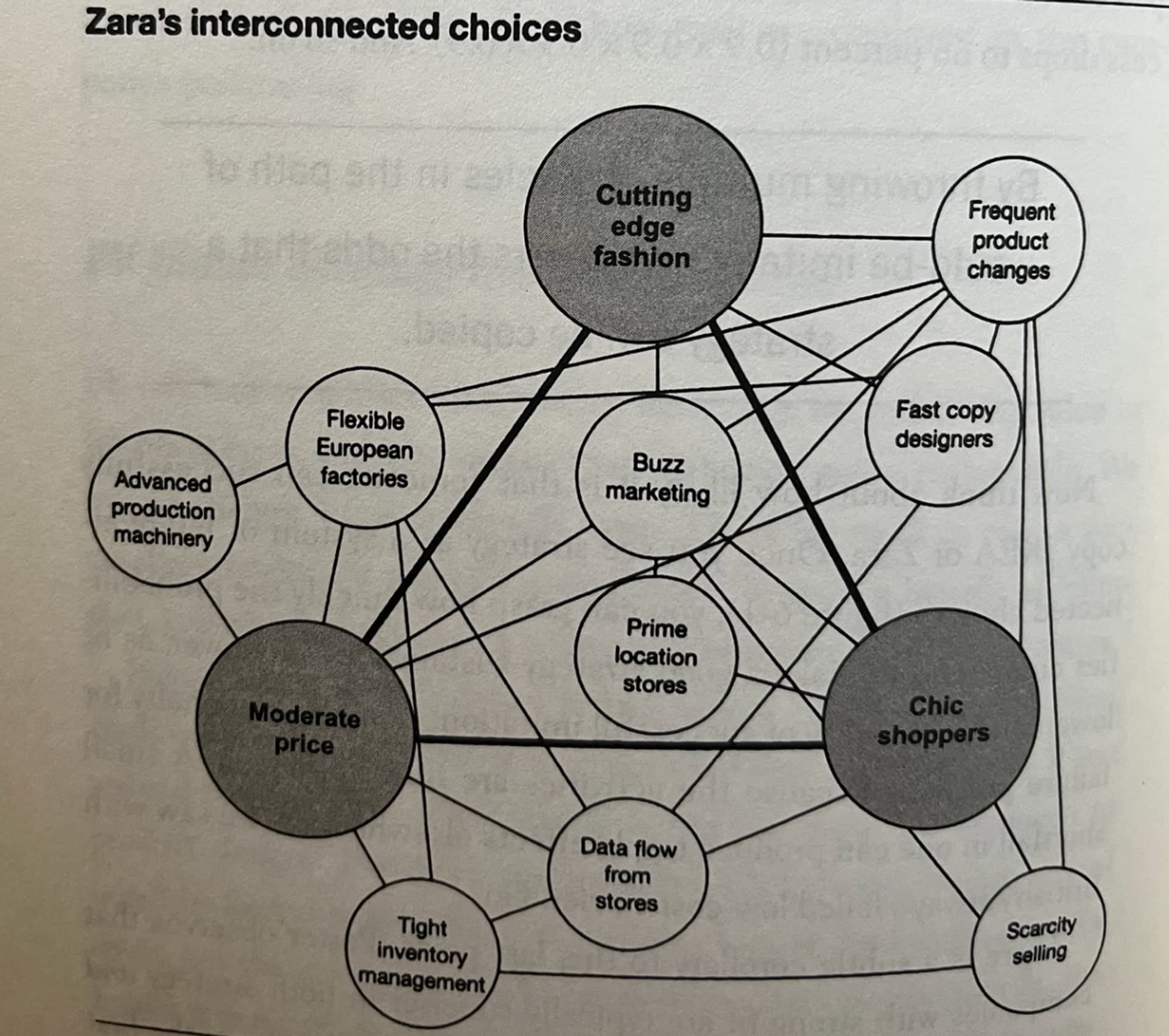
Zara’s advantage was not simply “fast fashion.” There are PLENTY of fast-fashion retailers. For Zara, speed was the outcome of a system. Store teams gathered information about what customers wanted. A wide variety of styles and frequent product changes created urgency and gave customers a reason to return. Flexible production and close coordination with factories allowed the company to respond quickly. Prime store locations built visibility, while frequent visits and word of mouth reduced its dependence on traditional advertising.
Each activity made the others more valuable. The store information mattered because production could respond. Fast production mattered because products could reach stores frequently. Frequent newness mattered because customers had learned that waiting might mean missing the item.
So when Zara decides what to invest in, it prioritizes things that make information move faster, stores that meaningfully add visibility and elevated artistic direction that keeps the brand adjacent to high-end fashion.
You can copy a Zara design or store layout. You cannot easily copy the entire business that allowed Zara to notice, produce, distribute and sell it before everyone was tired of the trend.
Over the past year and a half, I have built my own portfolio career almost accidentally.
I keep coming back to the activity system because it helps me understand why I do everything I do: content, writing, teaching creators, advising, speaking, podcasting, working with brands and writing a book. That list explains what I do, but it does not explain why those things belong together.
So I mapped it.
Below, I’m sharing the actual Alexis Barber activity system: how each part of my business produces the ideas, relationships, revenue, authority and information that make the other parts stronger—and why going back to the office is not a departure from the business I’ve built.
If you’re building your own portfolio career—or even trying to understand where a side hustle belongs—an activity system can show you whether the pieces of your business actually strengthen one another.
