


Quick note: the podcast is on pause this April as I work out some BTS production work. More Substack content for you in the meantime, enjoy!
Hello stars!
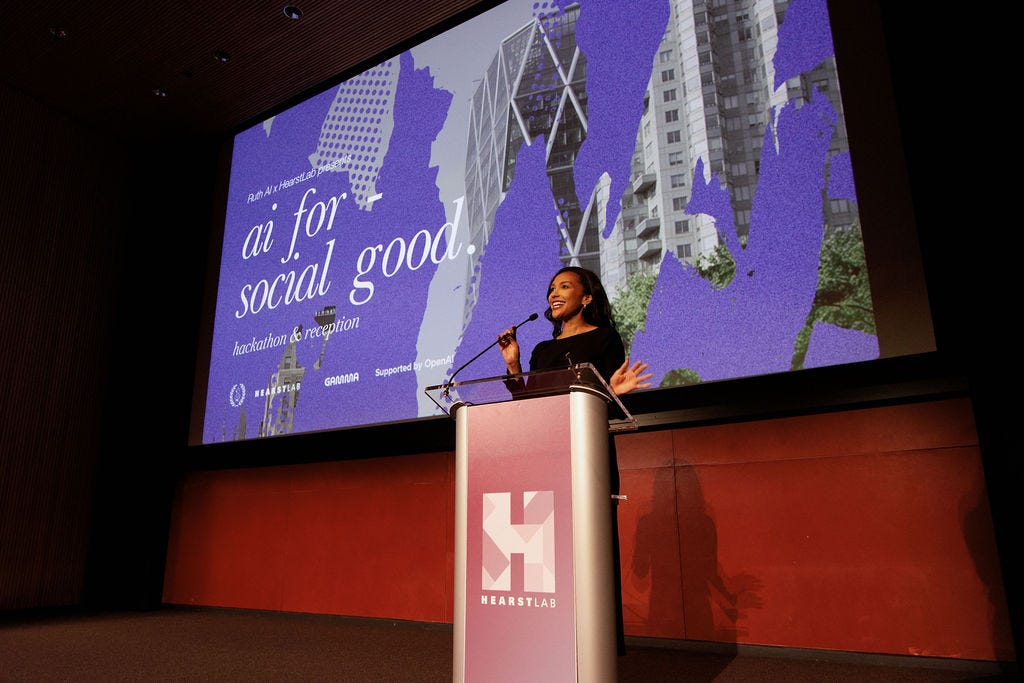
Last Thursday, I emceed the AI for Social Good Hackathon with HearstLab and Ruth.AI, expecting it to be a classic speaking engagement. I left rearranged, with the kind of bubbling, full-body urgency that shows up when you realize you’ve been falling behind on something that’s bigger than you thought.
Some noticings:
In eight hours, a team of young women built a full database to help people actually participate in local politics. It scraped government websites, let users track bills, find polling centers, and show up for the civic stuff most of us have quietly written off as too annoying to bother with. Everything that usually makes civic participation impossible (the logistics, the information buried on terrible government websites, the sheer friction of it) they dismantled. In eight hours.
Another woman built an AI-powered platform to help people with ADHD run their daily lives. Hello! Real solutions to real problems, focused on helping our communities. Useful. Fundable. Built by women, in a single day, with tools that are already accessible to all of us.
On the hackathon: of the 100+ women in the room, there wasn’t a single Black woman on a hackathon team, and there were fewer than three in the audience.
AI’s sheer power is dumbfounding, sure. But watching it be used for GOOD in real time is what put a battery in my back: our world is fundamentally shifting, and it is not waiting for us to feel ready.
The wealth transfer nobody’s warning you about
There is a wealth transfer taking place right now, and it looks nothing like the Boomer/millennial one you’ve heard about. This one is technological, and the stakes for women, specifically for Black women, are genuinely alarming.
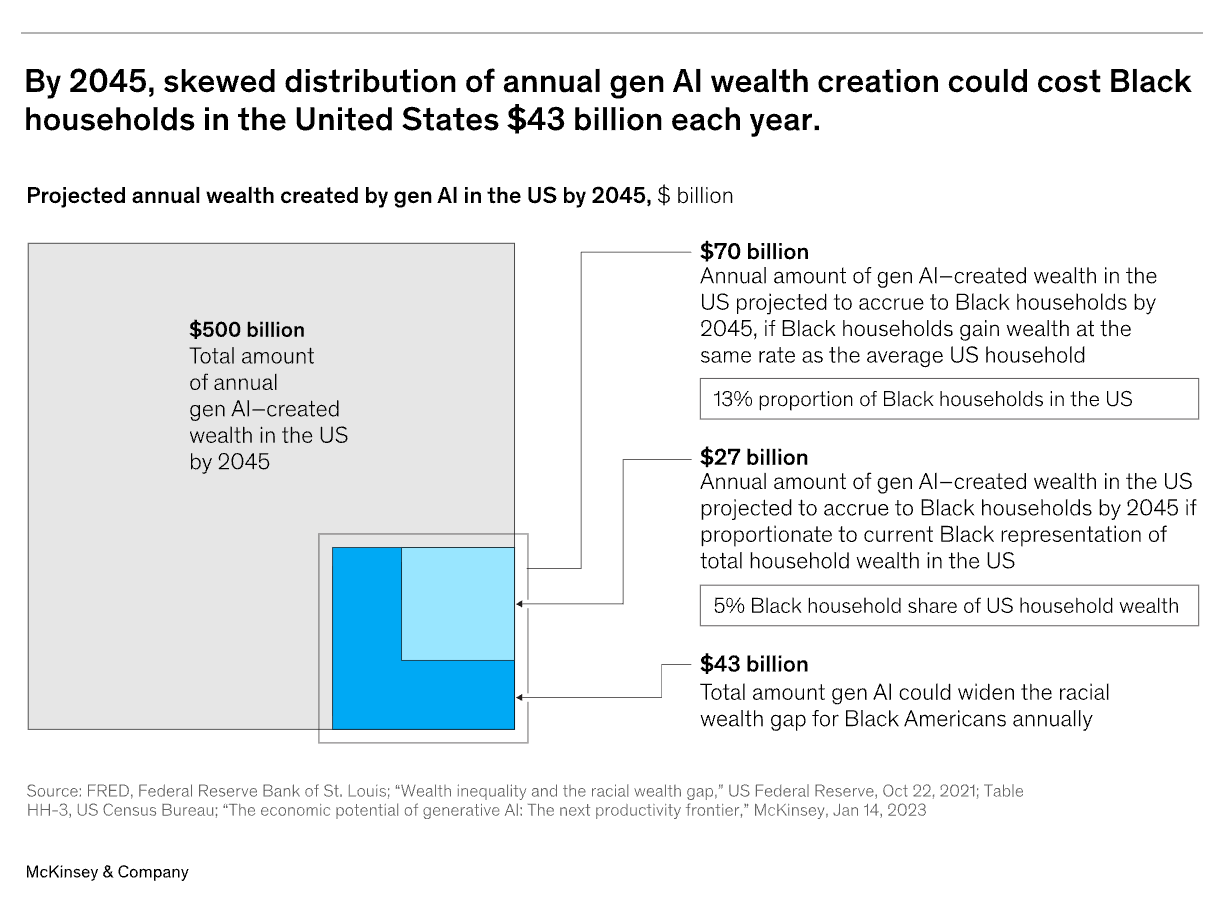
McKinsey ran the numbers: by 2045, the racially disparate distribution of new wealth created by AI could widen the wealth gap between Black and White households by $43 billion annually.
Makes me SICK to my stomach to think about!!! We know why that number exists: access and fluency with new technology always follow existing power. The people closest to the tools accumulate the advantage. Everyone else watches it happen until it’s too late.
And right now, women are watching it happen.
The numbers back this up. Women make up less than a third of AI professionals and only 18% of AI researchers globally. In the same job, women are 16 percentage points less likely than men to even use the tools. And here is the part that should make you furious: when women do push past the initial hesitation, they frequently outperform their male counterparts. The barrier was always access, training, and the confidence to start.
AI is set to bring an estimated $70B in wealth to the US in the next 20 years. That’s a HUGE opportunity for women and people of color to actually close our wealth gap…nothing to be scoffed at!
I understand why!!! I was in the same place: to AI or not to AI. The concerns are legitimate: what this means for jobs, for creativity, intelligence, for the communities we care about. I get the hesitation around something that feels like it was built by and for a very specific kind of person, in a very specific kind of room, with a very specific agenda.
The wake up call for me was that if men run this, massive power gets concentrated in rooms that have historically excluded us and have no intention to reduce bias against us, potentially destroying our society in ways we don’t really fathom at this point.
The women I watched build at that hackathon understood that. They didn’t wait until they felt fluent or until it felt safe or fully vetted or ideologically clean. They got in the room and built something that could change people’s lives.
I say this with so much love, and I say it because I am challenging myself to look at this, too: we have to stop getting caught up. The discourse, the debates, the moral purity olympics around who is allowed to use what tool and when. We can care deeply about the ethics and still build our wealth. We can hold real concerns and still show up to learn. We have to. Because the alternative is watching another generation of tools, platforms, and industries get built without us and then wondering, again, why the gap got wider.
What I was actually afraid of
The environmental critique was the respectable version of my fear. But for a few years there, I was just repeating what I’d heard other people say, not really researching AI for myself.
The real fear was scrutiny. Being the Black woman on the internet who publicly endorsed a technology that some people are going to look back very unfavorably. Ending up on the wrong side of an argument I hadn’t fully worked out yet. I still consider myself a novice, I feel behind every day, but I can see the economics of the situation and that’s enough to get me to take a second look.
Here’s what I worked through:
1. The environmental concern is real, and it is more complicated than that
I read a piece in Undark that reframed this entirely for me. The water and energy footprint of AI data centers is real and it varies wildly by location, technology, and season. In water-stressed areas, a single facility can strain an entire region’s supply. That deserves anger, and the lack of transparency from tech companies about their actual consumption is a legitimate scandal.
And then there’s context. A single burger takes more than 400 gallons of water to produce. A cotton T-shirt takes more than 700. The country’s 16,000 golf courses each use between 100,000 and 2 million gallons of water per day. Nobody interrogates those daily decisions with the same intensity.
But here’s what the article nailed: “A societal mass value judgement on AI is, fairly or unfairly, playing out in real time in the uproar around data centers. Part of the visceral environmental shame that folks like Masley feel from others about their AI use is probably less about the specific water footprint of a ChatGPT search than about the acceptance of a culture where AI is woven into everyday life, regardless of its environmental impact.”
AI deserves scrutiny. It is not going to be solved by the women who opted out. And practically speaking, it is here. The “should this exist” debate is closed. We are in the “who builds it, who profits, and who pays” phase now, and those questions are answered by the people in the room.
2. The threats to art, creativity, and politics are the actual thing I’m scared of.
This amazing carousel from Steph The Founder directs us to recent research about the real concerns of AI and how it is primed to do massive damage to our society. Creative jobs disappearing. Election manipulation. Deepfakes of real women. The hollowing out of entire industries that generations of women fought their way into. I am not rolling my eyes at any of it.
What I am saying is that every single one of those threats gets worse if the women who care about ethics, art, culture, politics, and the next generation of girls are not fluent enough to see the damage coming, call it out with precision, or build the alternative.
“I refuse to engage” is not a protective stance. It is a quiet one. And quiet has never saved any of us!
3. Scrutiny is the point. You cannot scrutinize what you do not understand.
The most useful critics of AI right now are the people who use it every day. They’ve seen what it can and cannot do. They know where the teeth are. The vague, outside-in criticism is losing to the specific, hands-on building, because you cannot meaningfully push back on a system you’ve never actually touched. If we want the critique to land, the critique has to come from women who’ve been inside the thing.
I get it. I also don’t know everything, and maybe this will blow up the world, but we can’t change that it’s here, so the smart thing to do is to learn how to engage with discernment and critical thinking!
I was you.
For two years I was “using AI” the same way most people are. Copy-pasting into ChatGPT, getting things maybe 20% faster, feeling vaguely ahead of the curve.
I was NOT ahead of the curve! I was dabbling. And dabbling is a sophisticated way of procrastinating!
About two months ago, I got sick of pushing this off and set a timer for 90 minutes to dive into Claude.
Since, my productivity and therefore impact have grown tremendously. What actually changed for me was building a real system around how my brain actually works instead of how I keep pretending it should: my ADHD, my creative energy patterns, my very specific and complicated business. Once the scaffolding was there, the part of my brain I actually want to be using (the creative, visionary, strategic part) finally had time to…think!
The shame spiral of not being able to perform got quieter, and my scattered, frantic energy has begun to subside.
That’s what’s available to you, and it starts with one 90-minute session!
Here is what I know. All of this is scary and confusing and I am not pretending otherwise. But I watched women at that hackathon build things that could genuinely change people’s lives, in a single day, and I cannot unsee that. AI can be used for good. If we let ourselves believe that, even cautiously, even with one eye on the risks, think about what we could actually do with it. So I am choosing to focus. Here is how I am doing that in my own life.
You don’t need to become an AI expert. You don’t need to build an app or learn to vibe code. You need to get familiar. Try something real. Stop waiting until it feels perfectly safe to engage with the thing that is already shaping your world whether you engage with it or not.
Ninety intentional minutes beats three years of passive skepticism. Every single time.
What’s coming this month
AI April is a three-part series for paid subscribers of TSFT. Here’s exactly what we’re covering:
This week (paid): The setup. How to audit your workflow, and the three things to take off your plate first.
Week 2: How I run my entire content business with Claude. The real system, the actual tools, what it replaced, and what it didn’t.
Week 3: Using AI to build and protect your personal brand. The frameworks I use to stay on voice, on brand, and on track without outsourcing my brain.
The machine is already here. The question is whether you’re going to understand it, or be understood by it.
I’ll see you on the other side!
